FENNEC
What OSHA Looks For in Industrial Robot Safety
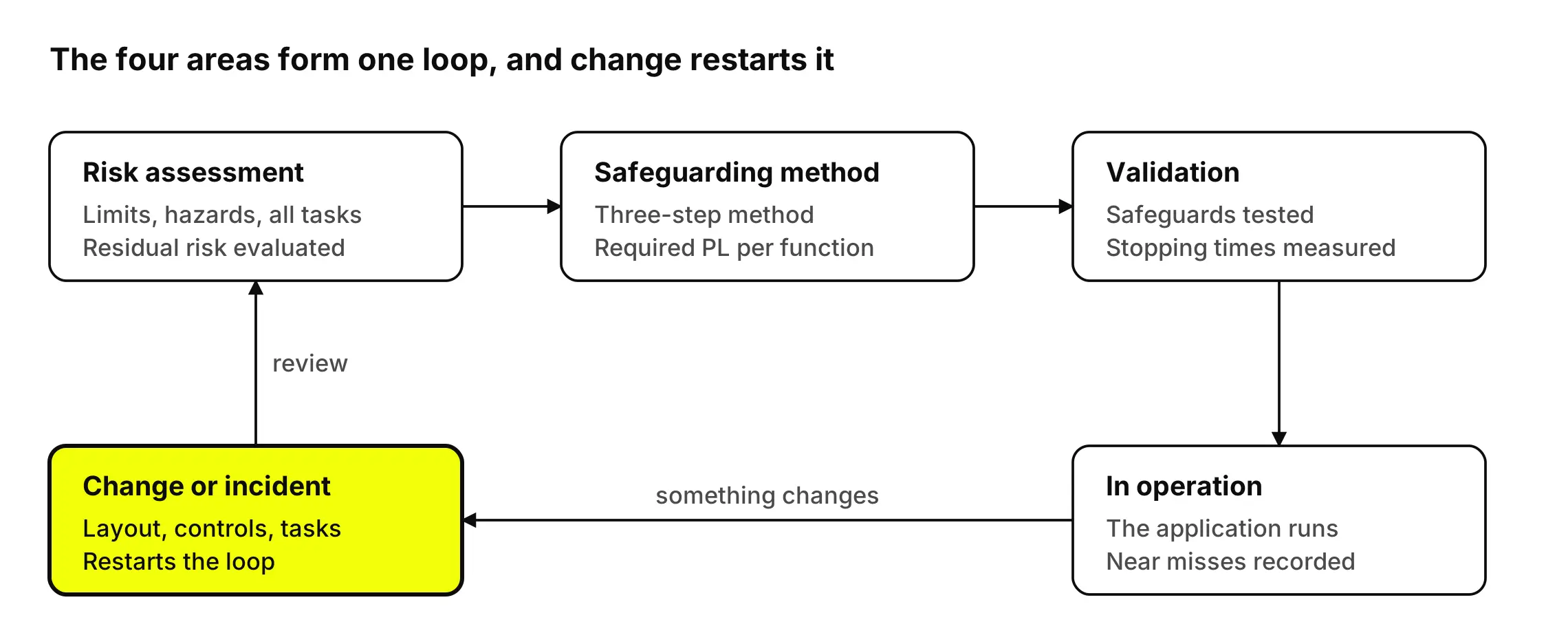
At the International Robot Safety Conference (IRSC), a safety specialist from OSHA shared the findings inspectors see most often around industrial robots. Most come down to four areas: the risk assessment, the method behind safeguarding, validation, and change. Here’s what good practice looks like in each, with a quick self-check for your own site.
Earlier this month, the Fennec team spent several days at the International Robot Safety Conference (IRSC) in Detroit. Now in its 37th year, IRSC is hosted by the Association for Advancing Automation (A3). It connects the people who write robot safety standards with the engineers, manufacturers, integrators, and end users who work with those standards every day. Its focus is practical: helping teams build safety into automation from the start rather than treating it as a final checkpoint [1]. We came home with pages of notes and a handful of themes that kept surfacing from one session to the next:
Much of the agenda centered on machinery safety fundamentals: risk assessment, safeguarding, and validation.
Machinery safety and functional safety practitioners often describe the same work in different vocabularies.
The new Part 3 documents for ANSI/A3 R15.06 and R15.08 place requirements directly on the sites that put industrial automation to work with robots [2].
Validation came up in several sessions as one of the hardest steps to get right.
Over the next few weeks, we'll take a closer look at several of these themes. We're starting with one of the most practical sessions of the conference: a presentation by a safety specialist from the Occupational Safety and Health Administration (OSHA) on how it approaches industrial robot safety.
When OSHA visits
An OSHA inspection usually starts with something that has already happened. Compliance Safety and Health Officers (CSHOs) typically arrive in response to an injury report or a complaint. Once on site, they review machine guarding and lockout/tagout, interview the people who work around the equipment, and reference consensus standards such as the ANSI B11 series, R15.06, and R15.08 [3].
One item in the presentation was simply a question: "Risk assessment?" Inspectors want to understand how the site decided what protection was needed, and the risk assessment is where that reasoning should live.
What OSHA finds most often
The presentation listed several common findings from robot-related inspections [3]. None of them involve exotic technology. Most come down to four areas of practice:
Area | Common findings from the presentation |
The risk assessment | No formal risk assessment; residual risk not evaluated |
The method | Safeguarding solutions applied without a methodology |
Validation | No validation; stop-time measurements not performed; safeguarding relied on as alternative protection during servicing and maintenance |
Change | In-house installation and integration; changes to safety-related parts of the control circuit; hydraulic and pneumatic energy not considered |
The grouping is ours, not OSHA's.
The risk assessment
OSHA's own guidance names the failure to identify hazards, including hazards that could have been anticipated, as one of the root causes of workplace injuries. It calls for hazard identification to be a proactive, ongoing process rather than a one-time exercise [4].
The IRSC presentation discussed why that matters legally as well as practically. To establish that an employee was exposed to a hazard, OSHA considers whether exposure could reasonably have been anticipated, whether arising from the nature of the work or from inadvertent actions [3]. A familiar example from automated environments: an operator spots a piece of scrap where it doesn't belong and reaches in to remove it. A routine, almost instinctive action that can lead to serious injury.
A risk assessment that holds up reflects how people actually work around the machine, not only how the procedure says they should. ISO 12100 gives a structured way to get there [5]:
Define the limits of the machine, including intended use and reasonably foreseeable misuse.
Identify hazards across the whole life cycle, including setup, maintenance, cleaning, and clearing jams.
Estimate and evaluate the risk for each hazard.
Reduce the risk, then evaluate what remains.
That last step speaks to another finding on the list: residual risk that isn't evaluated. Every safeguard can leave some risk behind. A sound assessment estimates that residual risk, decides whether it is acceptable, and records the reasoning.
The method behind safeguarding
The general machine guarding requirement in 29 CFR 1910.212 says that where a machine's point of operation exposes an employee to injury, it must be guarded, and the guarding must conform to appropriate standards [6]. The presentation also cited an Occupational Safety and Health Review Commission (OSHRC) decision holding that required guarding must not rely on the skill or attentiveness of employees [3].
A consistent methodology is what turns those requirements into decisions a team can explain. ISO 12100 sets out a three-step method, applied in order [5]:
Inherently safe design. Remove the hazard or reduce it through the design itself, for example by reducing speed or force or increasing clearance.
Safeguarding and complementary protective measures. Guards, protective devices, and safety functions such as light curtains, laser scanners, and enabling devices.
Information for use. Warnings, procedures, and training for the risk that remains.
When a safeguard depends on the control system, ISO 13849-1 connects the risk to a required Performance Level (PL) for that safety function [7]. Documenting each step, from the hazard to the measure chosen to the PL it needs, makes decisions consistent across machines, shifts, and engineers.
Validation
Installing a safeguard to mitigate a risk and showing that it works are two different things. It's easy to write "add an emergency stop" into a risk assessment. The harder part is installing it and testing that it actually stops the machine. Two of the findings sit right in that gap: validation and stop-time measurements.
Stopping time matters because it sets the safety distance. A protective device such as a light curtain or laser scanner only protects people if it is far enough from the hazard that the machine stops before a person can reach it. ISO 13855 covers how to calculate that distance, and the calculation depends on a measured stopping time [8]. Without the measurement, the distance is just an assumption.
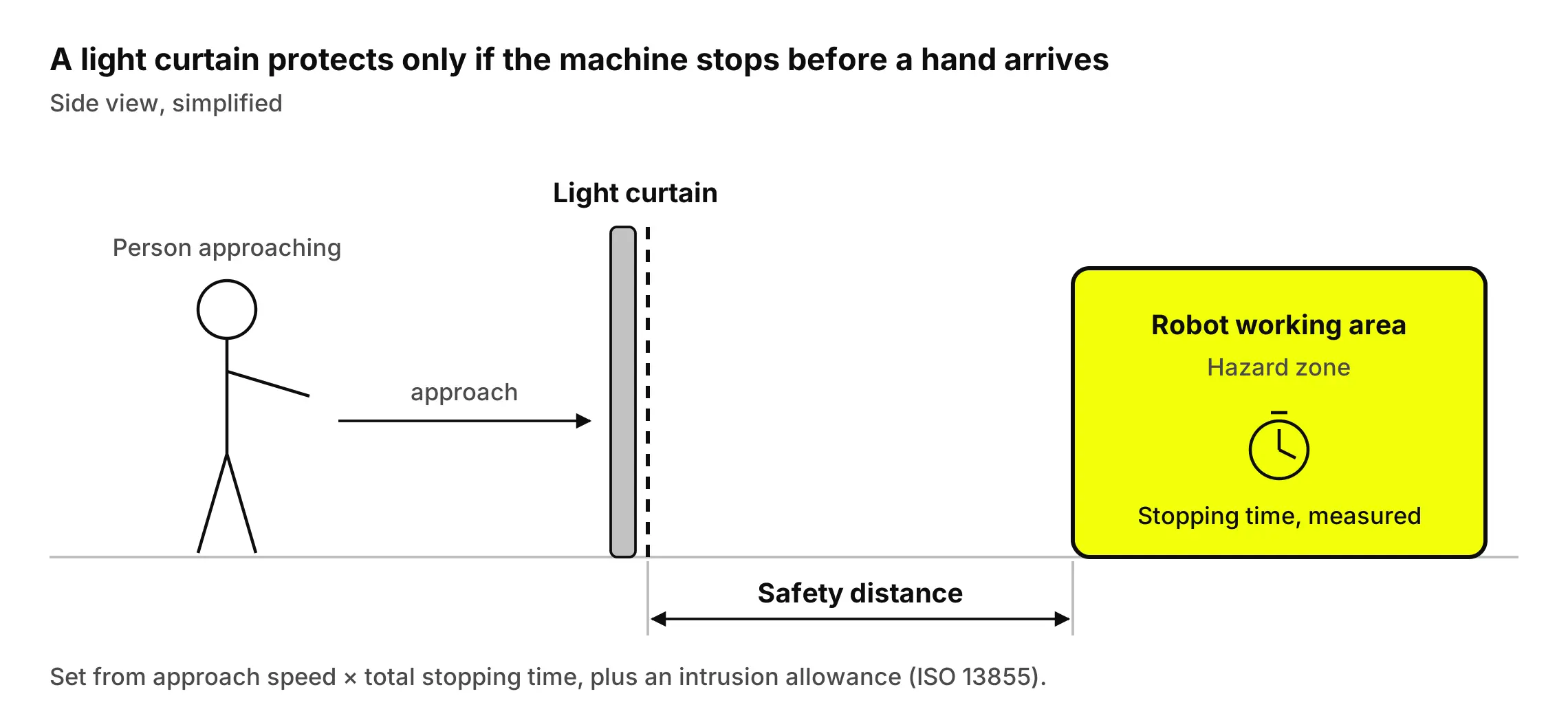
The safety distance is only as reliable as the stopping time measurement behind it.
ISO 13849-2 covers validating safety functions more broadly. It asks for confirmation, through analysis and testing, that each safety function does what the risk assessment requires and meets its required PL [7]. Validation evidence, such as test records, measurements, and results, belongs with the risk assessment it supports.
The list also included safeguarding relied on as alternative protection during servicing and maintenance [3]. Servicing typically calls for hazardous energy control, such as lockout/tagout. Where a site relies on safeguarding instead for specific tasks, that choice needs its own assessment and validation for those tasks.
Change
The remaining findings describe what happens when a robot application changes after it is first installed and commissioned: in-house installation and integration, changes to safety-related parts of the control circuit, and hydraulic and pneumatic energy left out of the analysis. In each case, the robot application changed and the risk assessment did not keep pace.
OSHA's guidance notes that hazards can be introduced over time as workstations and processes change and equipment wears. It recommends evaluating planned changes to operations, workflow, or equipment for hazards before making them [4].
The new Part 3 documents for R15.06 and R15.08 make the same point for sites that operate robots. They call for managing change in both the robot application and the environment around it [2]. We looked at Part 3 more closely in The Safety Case Goes to Work.
After an incident or near miss
OSHA has specific reporting requirements for serious incidents. Employers must notify OSHA within 8 hours of a work-related fatality, and within 24 hours of an amputation, loss of an eye, or inpatient hospitalization [9].
Reporting is one obligation. Learning from the event is another. OSHA's guidance recommends investigating incidents and near misses to find their root causes, and it cautions against stopping at a single trigger. If a worker made an error, a good investigation asks whether they had the right tools, training, time, and supervision [4].
What a site learns should flow back into the risk assessment. A near miss involving a robot may reveal a task the assessment never considered, a safeguard that behaves differently than expected, or a reach-in that turned out to be reasonably predictable after all. Each of those is a reason to revisit the hazards, the measures, and the validation evidence, before the next incident rather than after it. We explored this idea of a safety case that keeps learning from the field in The Safety Case Never Stops Learning.
A quick self-check for your site
The risk assessment
Is there a documented risk assessment for each robot application, and does it cover setup, maintenance, cleaning, and jam clearing?
Does it account for reasonably predictable behavior, such as reaching in to clear a part?
Is residual risk estimated and accepted on the record?
The method
Can you trace each safeguard back to the hazard it addresses and the reason it was chosen?
Does each safety function have a required PL?
Validation
Has each safeguard been validated, with records to show it?
Were stopping times measured, and do safety distances reflect those measurements?
Change
Do in-house changes, including changes to safety-related control circuits, trigger a review of the risk assessment?
Are hydraulic and pneumatic energy sources included in the hazard analysis?
Do incidents and near misses feed back into the assessment?
A place to start
The common thread in that list of findings is documentation that reflects the application as it really is: how the risks were assessed, why each safeguard was chosen, how it was validated, and how all of that kept up as the application changed. If OSHA asks how a site decided what protection was needed, that record is the answer.
To help teams get started, we've published a free Hazard Analysis and Risk Assessment (HARA) template. It follows the ISO 12100 process step by step: the limits of the machine, tasks across the life cycle, hazards, risk estimation, risk reduction measures, and residual risk.
When a spreadsheet stops keeping up, the ASAP Platform keeps hazards, safety functions, and validation evidence connected in one place. When something changes, teams can see what it affects and what needs another look.
Notes
Association for Advancing Automation, "International Robot Safety Conference," November 3 to 5, 2026, Huntington Place, Detroit.
ANSI/A3 R15.06-3-2025, Industrial Robots and Robot Systems: Safety Requirements, Part 3: Use of Industrial Robot Cells; ANSI/A3 R15.08-3-2026, Industrial Mobile Robots: Safety Requirements, Part 3: Use of IMR Applications.
Occupational Safety and Health Administration, Chicago Region, "An OSHA Perspective on Industrial Robot Safety," presented at the International Robot Safety Conference, November 4, 2026. Prior presentations.
Occupational Safety and Health Administration, "Hazard Identification and Assessment," Recommended Practices for Safety and Health Programs.
ISO 12100:2010, Safety of machinery: General principles for design: Risk assessment and risk reduction.
29 CFR 1910.212, General requirements for all machines.
ISO 13849-1:2023, Safety of machinery: Safety-related parts of control systems, Part 1: General principles for design; ISO 13849-2:2012, Part 2: Validation.
ISO 13855:2024, Safety of machinery: Positioning of safeguards with respect to the approach of parts of the human body.
29 CFR 1904.39, Reporting fatalities, hospitalizations, amputations, and losses of an eye as a result of work-related incidents to OSHA.